Technical hub
Shared naval architecture. Two superstructures.
A slender semi-displacement aluminium platform designed by Dixon Yacht Design. The engineering exists to make the experience effortless: quiet running, daily solar energy, and CE Category A design intent held in reserve.
Platform
Dimensional & structural specification
- LOA (length overall)
- 13.5 m
- Beam overall
- 6.6 m
- Hull form
- Slender semi-displacement multihull, ≥ 11:1 L/B per hull
- Keels
- Foam-filled structural mini-keels — kite tracking & tidal beaching
- Bridge-deck clearance
- 800 mm static
- Deployed weight — Explorer
- 7,270 kg base configuration (7,630 kg with the long-range battery)
- Deployed weight — Coastal
- 8,335 kg base configuration (8,695 kg with the long-range battery)
- Construction
- CNC-cut marine-grade aluminium (Sealium / 5083-H111)
- Insulation
- Spray-cork thermal & acoustic lining
- Fresh water capacity
- 400 L symmetrical — 2 × 200 L integral structural lower-hull tanks (both models)
- Tender & toys
- True Kit 400 with ePropulsion Spirit 2.0 outboard (indicative fit-out)
- Certification
- Designed to CE Category A (Ocean)
Superstructures
One platform, two personalities.
Switch between the two superstructures to see how the same naval architecture is deployed.
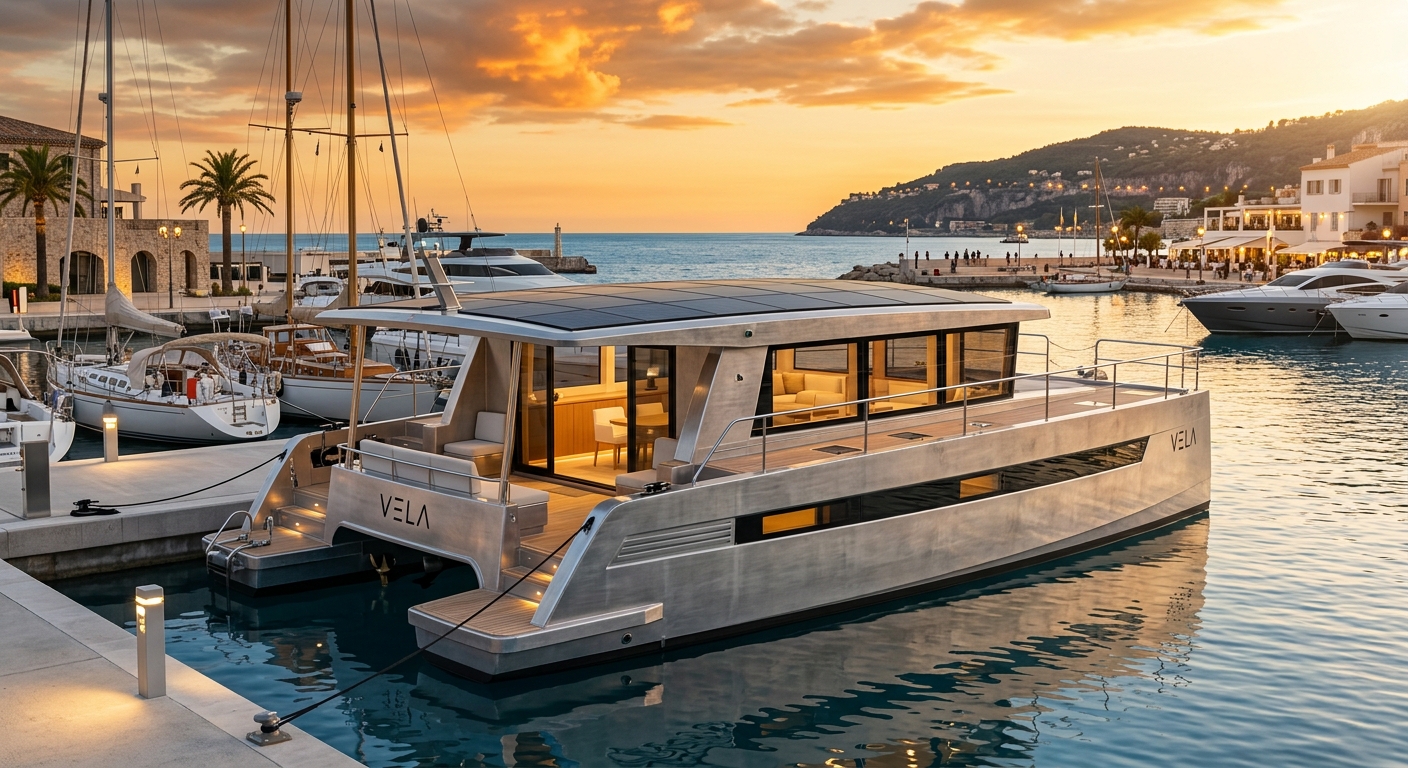
Model A — Full length saloon
Explorer Edition
Prioritises internal volume, maximum all-weather protection and an expansive full length main cabin for liveaboards, high-latitude explorers and extended-cruising couples.
- Full length main saloon with panoramic glazing
- Single offshore-safe front access door
- Integrated indented handrails on the aluminium roof top
- Optimised for liveaboard and blue water passage-making
- Capacity
- 4 private guests (short-handed setup)
- Deployed weight
- 7,270 kg deployed
- Tender & toys
- True Kit 400 + ePropulsion Spirit 2.0
5.0 kts solar cruise (design target)
Drivetrain
Propulsion, energy systems & hydro-regeneration
- Engines
- Twin ePropulsion high-voltage pods, fixed under-hull
- Steering
- Independent mechanical transom-hung rudders
- Energy reservoir
- ePropulsion 96 V lithium — 47.0 kWh standard (2 × 23.5 kWh, one block per hull)
- Long-range battery option
- +2 × 23.5 kWh, one per hull = 94.0 kWh total (extra batteries must match the installed 23.5 kWh model) (via equipment pack)
- Power conversion
- DC-DC step-down to isolated 24 V and 12 V circuits
- Solar array
- ~38 m² Maxeon all-black rigid glass modules, rail-mounted on the hardtop with airflow beneath
- Peak solar output
- ~7.5 – 8.0 kWp (Victron SmartSolar MPPT)
- Auxiliary drive
- Manual 40 m² LibertyKite® (Beyond the Sea) — specified; automated system optional
- Deck hardware
- Reinforced cleats/padeyes, backing plates to bulkheads
- Regeneration
- Hydro-regeneration under kite — intended ePropulsion CAN-bus integration
Energy
Mediterranean solar yield profiles
Indicative daily harvest from the ~38 m² hardtop array across the cruising year.
Jun – Aug
Summer peak
~32 – 40 kWh/day
6.5 – 8 sun hours/day
Apr – May / Sep – Oct
Spring / Autumn
~20 – 26 kWh/day
4 – 5 sun hours/day
Nov – Feb
Winter low
~10 – 15 kWh/day
2 – 3 sun hours/day
Continuous solar input vs. propulsion demand
Daily totals matter for the bank, but infinite range is decided second by second: whenever live array output exceeds the pods' draw, the yacht cruises on sunlight alone. At 5.0 kts in benign conditions the twin pods draw ~2.6 kW (twin epropulsion pods, benign conditions — flat water, no adverse current, ~1.3 kw per pod.), plus roughly ~0.4 kW of hotel load.
| Sky condition | Live array input | Pods at 5.0 kts | Result |
|---|---|---|---|
| Clear summer midday | ~6.0 – 6.8 kW | ~2.6 kW | Cruise + hotel load covered, surplus charges the bank |
| Light / high cloud | ~3.5 – 4.5 kW | ~2.6 kW | Cruise + hotel load covered, modest surplus |
| Broken cloud | ~2.5 – 3.2 kW | ~2.6 kW | Break-even to slight surplus at 5 kts |
| Heavy overcast | ~0.8 – 1.5 kW | ~2.6 kW | Shortfall drawn from the 47 kWh bank |
Range modes
Three honest ways of stating range. Battery-only figures assume no solar and no kite; solar-assisted figures depend on irradiance.
Battery only (no solar, no kite)
~55 – 65 nm at 5.0 kts · ~30 – 35 nm at 6.5 kts
~110 – 125 nm at 5.0 kts with the 94.0 kWh long-range bank
Night passages, prolonged overcast or engine-only manoeuvring. Overnight reserve mode holds 3.8 kts (Explorer) / 3.5 kts (Coastal) for 12 hours on the battery alone.
Daylight solar-assisted
Effectively unlimited at 5.0 kts (Explorer) / 4.5 kts (Coastal)
Conditional on irradiance — see the solar yield and live-input tables
In clear to lightly clouded Mediterranean conditions the array covers propulsion plus hotel load and still charges the bank. Under heavy overcast the shortfall is drawn from the battery.
Kite assisted + hydro-regeneration
4.4 – 4.5+ kts overnight with a small net battery gain
~1.1 kW regenerated above ~6 kts under kite (twin pods)
The kite carries the boat while the pods free-wheel. Output follows ePropulsion's published curve, so speed matters: below 5 kts regeneration mostly offsets the hotel load, and above 6 kts daylight solar starts each morning from a fuller bank.
Hydro-regeneration under kite power
The manual 40 m² LibertyKite® drives the yacht downwind while both ePropulsion pods freewheel as generators — with intended CAN-bus integration authorising regeneration back into the 96 V bank. The dashed line is a single 20 kW pod; the solid line is the installed twin-pod configuration.
Meaningful passive recharging begins above ~6 knots under kite
Read from ePropulsion's published Pod Drive 20 eSSA hydrogeneration curve, output rises steeply with boat speed and only plateaus (~1.75 kW per pod) beyond 10 kts. At 3 – 4 kts the twin pods return ~0.2 – 0.45 kW, which covers part of the hotel load rather than building charge; at 5 kts ~0.65 kW roughly balances it. Above ~6 kts the pair returns ~1.1 kW and the bank starts to refill. Kite regeneration supplements the solar array; it does not replace it.
3 – 4 kts under kite
~0.20 – 0.45 kW
Partial hotel-load offset only — this trickle does not build charge in the bank.
5.0 kts under kite
~0.65 kW
About 0.33 kW per pod — roughly balances the ~0.4 kW hotel load.
Above ~6 kts under kite
~1.1 kW
About 0.55 kW per pod at 6.5 kts — the point where the bank starts to refill overnight.
Auxiliary drive
LibertyKite® 40 m² by Beyond the Sea
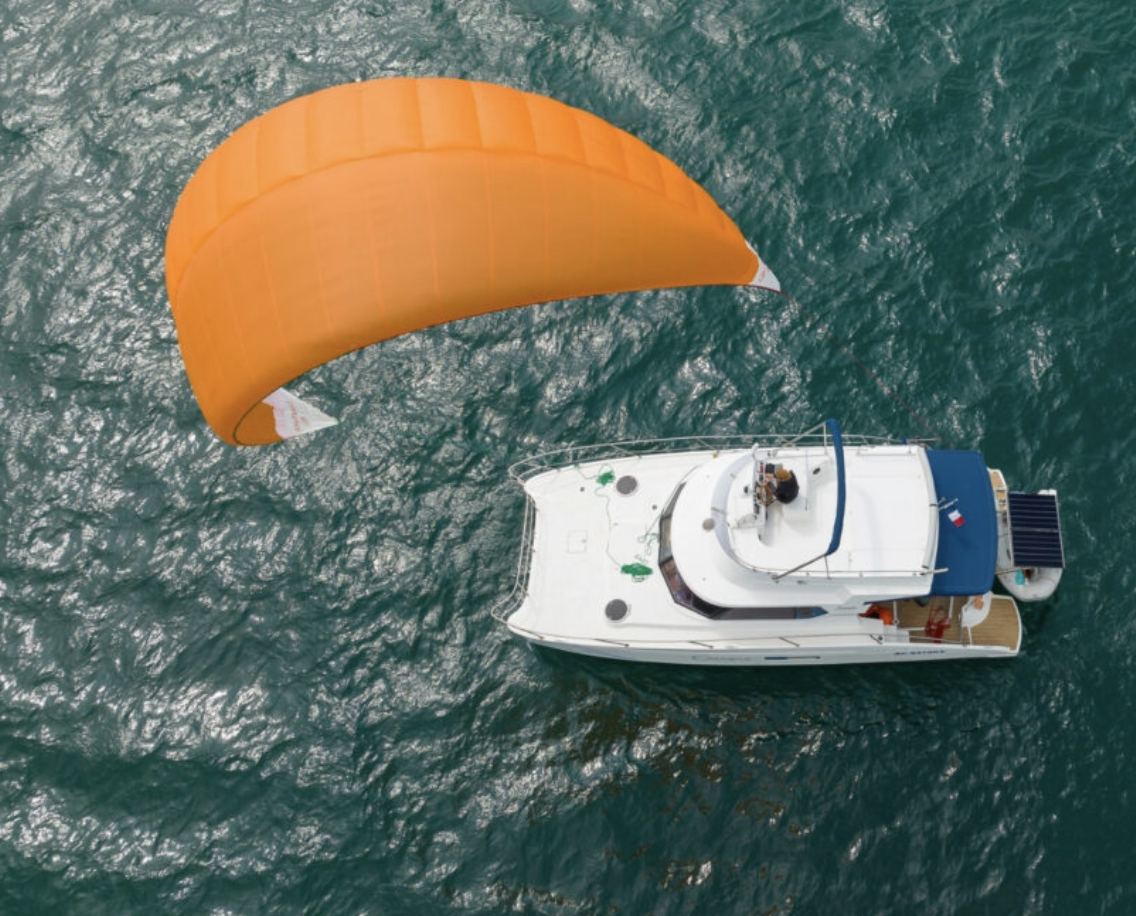
A manual 40 m² LibertyKite® traction wing is specified as the standard auxiliary, flown from the foredeck on downwind and reaching passages. It adds quiet, low-heel assistance and extends range without a mast, sails or standing rigging — and while it pulls, both pods free-wheel as generators.
Reinforced cleats and load paths as standard
Kite loads are steady and long-duration, so they are engineered into the structure rather than carried by deck hardware alone. Every Halo leaves the yard with structurally backed foredeck cleats and kite load points: doubler plates welded into the aluminium deck, loads tied through to the underlying frames and bulkheads, and chafe-protected lead points sized for sustained flying. No retrofit, no owner-fitted padeyes, and no limit on extended kite use in suitable conditions.
The foam-filled structural mini-keels give the tracking needed to hold a course under kite, and intended CAN-bus integration would authorise hydro-regeneration back into the 96 V bank while the kite is flying — see the regeneration curve above for realistic recovery at each speed.
The kite is an assistance system for suitable wind and sea states, used at the skipper's discretion. It is not a primary propulsion or safety system.
Virtual Anchor Mode
Hold position without dropping chain.
Electric dynamic positioning uses GPS and the twin pods to hold the yacht in place for a swim or lunch stop. There is no engine idling and no generator running — the stop is genuinely silent, and conversation carries across the cockpit.
Nothing is dragged across the seabed, so protected Posidonia seagrass meadows stay intact where anchoring would otherwise be restricted or damaging. In calm daylight the array typically out-produces the station-keeping and hotel draw, so the bank is level or rising by the time you get under way again.
Intended for short stops in suitable conditions, at the skipper's discretion. It is not a replacement for ground tackle and not a safety system; the yacht carries offshore-grade anchoring equipment as standard.